Best Online Brokers for Beginners and Intermediate Investors
Top Technical Analysis Tools for Traders


Why Choosing the Right Broker Matters
Choosing the right broker is one of the most important decisions when
starting to invest.
A good broker should be easy to use, transparent with fees, and offer
tools that match your experience level.
This comparison focuses on safety, usability, and learning support,
not on unrealistic promises or quick profits.
When choosing an online broker in 2026, investors should consider fees, platform usability, available assets, and educational resources. Here’s a comparative overview:
Fees & Commissions: Many brokers now offer $0 commissions on stocks, ETFs, and options, making it easier for beginners to start investing without high costs. Some platforms have low fixed fees or small spreads for international trades.
Platform & Tools: Modern brokers provide intuitive web and mobile platforms with advanced charting, technical analysis tools, and real-time data. Beginners benefit from simpler interfaces, while intermediate investors can access more advanced trading tools and analytics.
Available Assets: Most brokers support stocks, ETFs, options, and cryptocurrencies, with some offering access to global markets and fractional shares. Diversification is easier than ever.
Education & Support: Beginner-friendly brokers include educational content, tutorials, webinars, and demo accounts to help investors learn while trading. Social trading features, like copying experienced investors, are also growing in popularity.
Ideal User Profiles:
Beginners: Platforms with low or zero fees, easy-to-use interfaces, educational resources, and fractional shares.
Intermediate Investors: Platforms offering more advanced trading tools, global market access, options, futures, and risk management features.
Key Takeaway: In 2026, the best brokers combine affordable fees, user-friendly platforms, diversified assets, and strong educational support, allowing both beginners and intermediate investors to start building wealth confidently.
Best Online Brokers for Beginners and Intermediate Investors (2026)
If you’re new to investing, prioritize brokers with intuitive apps, educational resources, low minimums, and simple tools like demo accounts or social copying. These EU-regulated options (e.g., by BaFin, CySEC, or FCA) are accessible in Spain and focus on ease of use with low fees for stocks, ETFs, and basic portfolios.
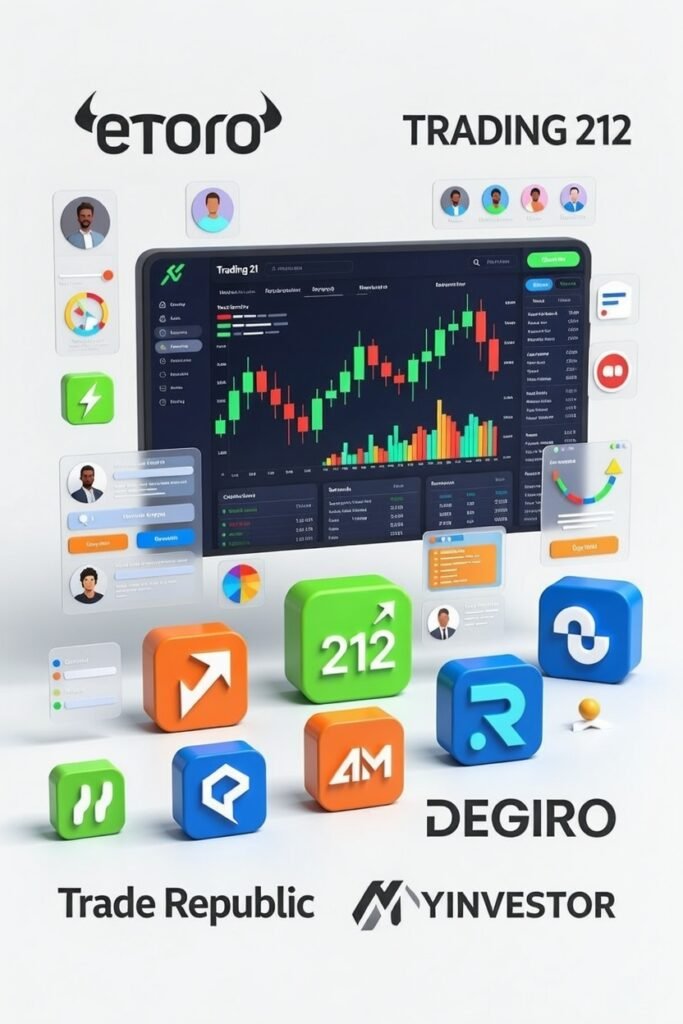
- eToro: Offers social trading (copy experienced investors), demo account, fractional shares, and access to stocks/ETFs/crypto/CFDs. Fees include 0% commission on stocks/ETFs (spread applies, ~0.09-0.75%); withdrawal $5; inactivity $10/month after 12 months. Pros: User-friendly app, great for learning via community; high interest on cash (up to 3.55% USD). Cons: Higher spreads on some assets; limited advanced tools.
- Trading 212: Provides commission-free trading, auto-invest plans, fractional shares, and access to stocks/ETFs (16 markets). Fees: 0% on stocks/ETFs; FX conversion 0.15%; no inactivity/withdrawal fees. Pros: Simple mobile app (4.9/5 rating); quick account setup; ideal for DCA (monthly investments). Cons: No bonds/options; limited research depth.
- DEGIRO: Covers stocks/ETFs/funds (29 markets), with educational materials and a mobile app. Fees: €1 handling + €1 for US stocks; €2.50 annual exchange fee; no inactivity fees. Pros: Very low costs; seamless opening; good for passive ETF investing. Cons: No demo account; no forex/crypto; basic support.
- Trade Republic: Features auto-invest (DCA), stocks/ETFs, and banking integration (card with 1% saveback). Fees: 1€ per one-shot order (plans free); spread applies; 2.02% on cash balances. Pros: Beginner-friendly app; no minimum deposit; high user ratings for simplicity. Cons: Spread can add up on illiquid assets; occasional withdrawal delays reported.
MyInvestor: Focuses on index funds (S&P 500/MSCI World), Spanish bank integration, and robo-advisor options. Fees: 0.15% annual on funds; no custody fees; 0.75% on cash. Pros: Low fees for long-term indexing; €25 welcome bonus; tax handling simplified. Cons: Limited to funds/ETFs; no advanced trading.
These are great starting points—many users in Spain praise Trade Republic and MyInvestor for hassle-free DCA into ETFs. Always verify tax implications (e.g., Spanish withholding) and start with a demo if available.
Key Considerations for Investors in 2026 (General and US Focus)
These factors apply across regions, though specific rules and protections can vary depending on the investor’s location. Always verify local laws, broker terms, and tax obligations before investing.
Regulation:
Choose brokers regulated by reputable authorities to ensure investor protection. In the US, this typically means oversight by the SEC and FINRA, with SIPC insurance covering up to $500,000 per account (including $250,000 for cash) against broker failure. Globally, look for brokers compliant with local regulations and investor protection schemes. Prioritize firms with strong fraud prevention and compliance records to safeguard your funds.
Taxes:
Tax treatment depends on your residency and investment type. In the US, long-term capital gains (investments held over a year) are taxed at 0–20%, while short-term gains can reach up to 37%, based on income brackets. Brokers report via Form 1099-B, and new reporting rules for digital assets require Form 1099-DA for recent transactions. International investors should consider implications for dividends, interest, and cross-border holdings. Consulting a tax advisor is recommended to avoid surprises.
Availability:
Not all brokers operate globally. While many US brokers serve domestic clients effectively, some limit access to international users. Conversely, certain international brokers provide global access but may restrict US residents. Always verify access directly with the broker and consider any residency or compliance requirements.
Trends in 2026:
Expect moderate to above-trend economic growth, potential easing of interest rates (e.g., Fed funds around 3% in the US), and increasing adoption of AI in trading platforms for smarter tools and personalization. Competitive features include high yields on cash balances (3–5% in the US, slightly lower globally) and mobile-first platforms. Investors report better support, educational content, and tools for sustainable and crypto-focused investing.
Advice:
Match your broker to your investment goals. Use low-cost platforms for long-term strategies (e.g., ETFs or index funds) and advanced platforms for active trading. Start small, try demo accounts when available, and prioritize low fees, education, usability, and regulatory transparency. This is general guidance and not financial advice—conduct thorough research and consult professionals for personalized strategies.