
How Much Should You Risk Per Trade ? Complete Beginner’s Guide to Risk Management in 2025
Most beginner traders focus on “how much can I make?” and completely ignore the far more important question: how much am I willing to lose? This is the difference between surviving in the markets for years and blowing up your account in weeks. Statistics show that 70–90% of retail traders lose money long-term, and the #1 reason is poor risk management—not bad ideas or predictions.
A solid risk management plan lets you:
- Survive inevitable losing streaks (even pros have them)
- Keep emotions in check and avoid impulsive decisions
- Grow your capital steadily instead of chasing big wins
In this complete guide, you’ll learn:
- The 1–2% rule and why it’s the professional standard
- How to calculate position size in stocks, forex, and crypto
- Expanded common mistakes + how to avoid them
- Integration with risk-reward ratio and daily/total risk limits
- Real-world examples with visuals
- How to use the free Risk Calculator
By the end, you’ll have a professional framework to protect your account from day one.
What Is Trading Risk?
Trading risk is the exact amount of money you’re willing to lose on a single trade if it goes against you. It’s not the same as position size: you can invest $10,000 but only risk $100 (by placing a tight stop loss).
Risk = (Entry Price − Stop Loss Price) × Number of Units (shares, lots, coins)
Why Risk Management Matters
- Capital preservation: A 50% loss requires a 100% gain just to break even. Controlled risk prevents catastrophic drawdowns.
- Emotional control: Small losses = less stress, no panic selling or revenge trading.
- Long-term consistency: Gives you time to learn from mistakes without going broke.
- Statistical edge: Even with a 50–60% win rate, proper risk turns a strategy profitable.
How Much Should You Risk Per Trade?
The most widely accepted rule for beginners is risk no more than 1% of your total account per trade. Some experienced traders go up to 2%, but for beginners, 0.5–1% is safer.
Risk Percentage Examples
| Account Balance | Risk % | Dollar Risk per Trade | Max Consecutive Losses to -20% Drawdown |
|---|---|---|---|
| $1,000 | 1% | $10 | 20 losses |
| $5,000 | 1% | $50 | 20 losses |
| $10,000 | 0.5% | $50 | 40 losses |
| $10,000 | 2% | $200 | 10 losses |
Tip for beginners: Start with 0.5% or less. At 1% risk, you can survive 20 consecutive losses and only lose 20% of your account (recoverable). At 5% risk, just 4–5 losses wipe out 20–25% (much harder to recover).
How to Calculate Your Risk Per Trade
Common Beginner Mistakes
- Risking too much due to “confidence” — Confidence doesn’t change probability. Stick to 1–2%.
- No stop-loss — Unlimited losses.
- Revenge trading — Increasing size after losses.
- Overtrading — Too many positions = high cumulative exposure.
- Ignoring volatility — Same size on high-vol stocks vs stable ones.
- No written plan — Emotional decisions.
- No total open risk limit — 5 trades at 2% = 10% simultaneous risk.
- Changing rules mid-streak — Breaks consistency.
Position Sizing Strategies
- Fixed % of account — Scales with growth/shrinkage (best long-term).
- Fixed dollar amount — Simple, but doesn’t adjust to account size.
- Volatility-based (ATR) — Use Average True Range to adjust stops and sizes in volatile markets.
- Daily/weekly caps — No more than 3–5% risk per day, 10% per week.
Practical Examples
Scenario 1: Losing Streak
- $10,000 account, 1% risk ($100)
- 10 losses in a row → -$1,000 (10% drawdown) → account at $9,000
- At 5% risk → -$5,000 → account at $5,000 (very hard to recover)
Scenario 2: 1:3 R:R
- Risk $50, target $150
- 4 losses + 2 wins = -$200 + $300 = +$100 net
Risk Management Tips
- Never exceed 2% per trade.
- Always set stop-loss before entering.
- Keep a trade journal (entry, exit, reason, emotion).
- Adjust for volatility (use ATR or VIX).
- Limit simultaneous open risk to 5–6%.
- Pause after 3 consecutive losses or -3% daily.
- Review weekly drawdown and adjust % if account shrinks.
- Use the Risk Calculator every time.
How to Combine Risk Management with Your Strategy
- Identify setup (pattern, indicator).
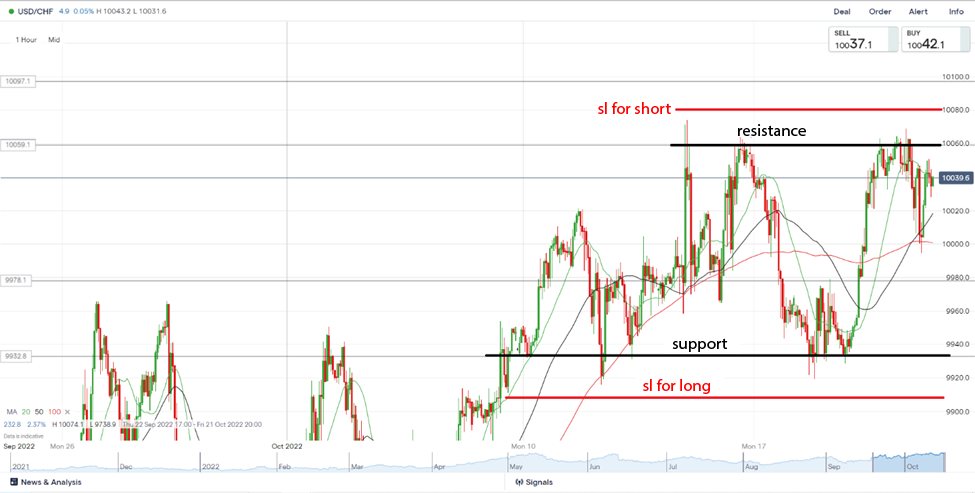
- Define technical stop-loss (below support, multiple of ATR).
- Calculate position size with Risk Calculator.
- Set take-profit (minimum 1:2 R:R).
- Enter only if everything aligns.
- Monitor without interfering.
- Log and review post-trade.
Why Beginners Fail Without Risk Management
No rules → random losses → emotions → account blow-up before the learning curve.
With 1% risk → survive 50–100 losing trades → time to improve win rate and discipline.
FAQ
Q1: Can I risk more if I feel very confident? No. Confidence doesn’t alter probability. Pros stick to 1–2%.
Q2: Should I increase risk after wins/losses? No. Keep it fixed. Emotional adjustments lead to blow-ups.
Q3: Is <1% risk okay? Yes—especially at the start. 0.25–0.5% is perfect for learning without pressure.
Q4: What about high leverage (forex/crypto)? Leverage amplifies risk. Always apply the 1% rule to your actual equity, not margin.
Q5: How much total open risk? Maximum 5–6% simultaneous. Example: 4 trades at 1.25% each.
Conclusion
Risk management isn’t exciting—it’s what separates traders who last years from those who vanish in months. The 1% rule (or less), combined with strong R:R and discipline, gives you the foundation for sustainable growth.
Remember: Priority #1 is preserving capital. Profits come second.
Start small, stay consistent, use the Risk Calculator on every trade, and log everything. Over time, discipline becomes your biggest edge.